Crescent & Star
Faith, set at the head of the shield — because everything taught beneath it answers to that first. Islam here is not a subject on the timetable; it is the ground the timetable stands on.
No active announcements.

Our Founding and Our Standard
A hybrid Islamic and secular institution in Ikorodu, Lagos State — built on the conviction that a child raised well in both faith and knowledge will want for neither, and named in honour of a father who believed exactly that.
A Word From Our Founder
It is my privilege to welcome you to Sultan Hanafi Royal Schools, a hybrid Islamic and secular institution built in Ikorodu, Lagos State, on a single conviction: that faith and scholarship are one inheritance, not two, and that a child raised well in both will want for neither. As Director, I hold our staff and our institution to that standard in a school that is secure, orderly and genuinely inclusive.
My father, Anofi Aliu Akano, was a clerk at the Nigerian Ports Authority. He did not live to see this school. It was built after he died, in the year my younger brother and I were serving the country under the NYSC, which is to say it was built by two young men with very little, out of an obligation neither of us had to discuss with the other.
The two decades I then spent in banking, insurance, oil and gas, and consulting taught me the unglamorous half of building an institution. Governance is what keeps a good intention alive after the person who had it has gone. An organisation without accounts, minutes and published policy has good intentions and nothing else. That is the discipline I have tried to put underneath this school: a Board of Governors that can overrule me, policies any parent may read in full, and a register in which every result and every certificate we issue can be checked long after all of us are gone.
Our doors are open to Muslims and non-Muslims, to sons and daughters alike. Every educator here is expected to send a child out able to sit a national examination, hold a Qur'anic text in memory, argue a position honestly, and earn a living, and to be judged on whether that happens. You are welcome here: the family enquiring for the first time, the family already with us, and the graduate who has come back to look.
Faith and scholarship are not rival inheritances. They are one and the same.Dr. Zakariya Olanrewaju Anofi · Founder, Chairman of the Board of Governors & Head of Schools
Our Story
Sultan Hanafi Royal Schools was founded by Dr. Zakariya Olanrewaju Anofi — a chartered accountant — in July 2016.
The school takes its name from the founder's late father, Anofi Aliu Akano — a clerk at the Nigerian Ports Authority whose own education was limited, but who was determined that his children would have the opportunities he didn't. Building the school became a way to honour that legacy after his father's passing, during a period when the founder and his younger brother were serving the nation during their NYSC year.
The idea took shape years earlier, during Lagos Governor Babatunde Fashola's administration, and was carried through with the encouragement of the founder's mentor, Governor Seyi Makinde, his brother Lukman Olajide Anofi, and others. Rooted in the Imowonla community in Ikorodu, the school has grown into a byword for what focused, values-led education can do for an underserved area.
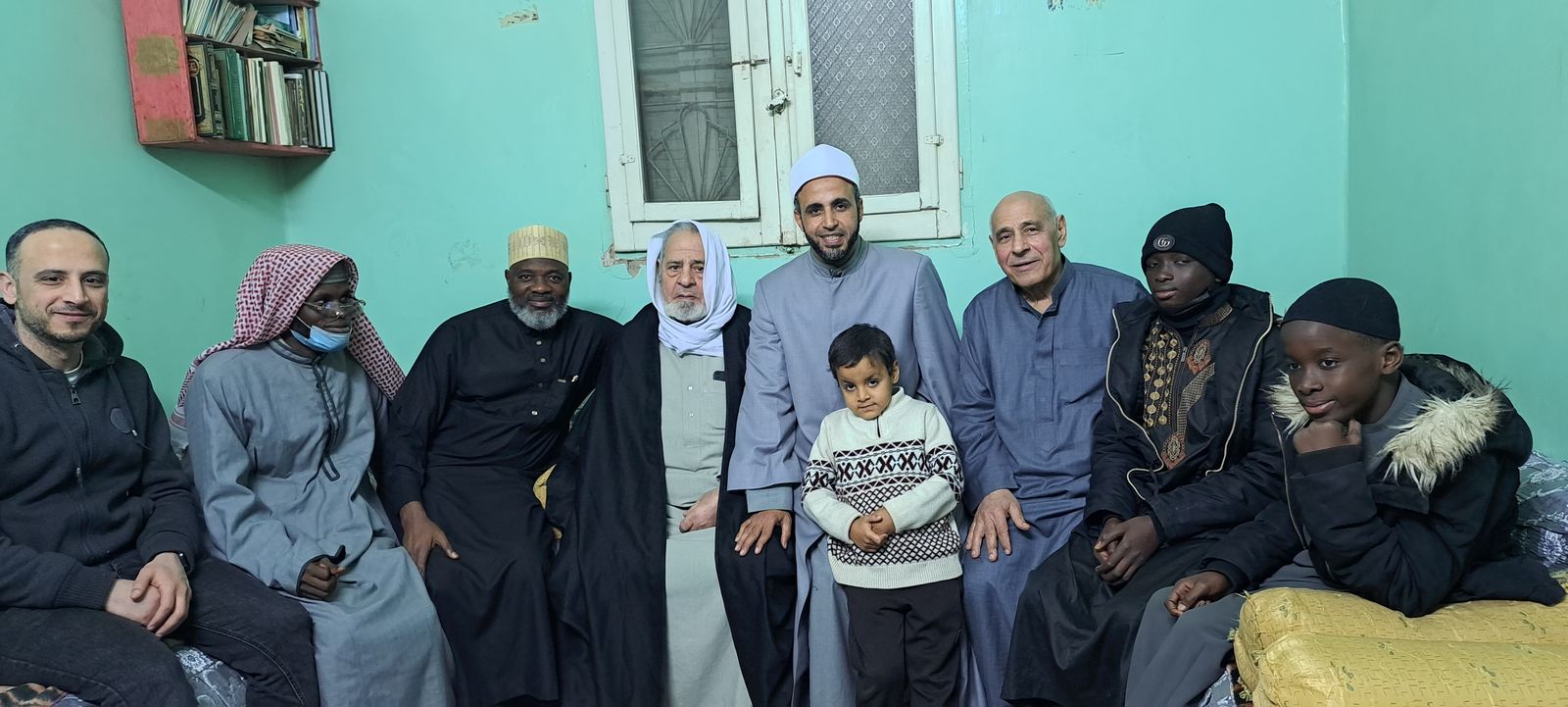
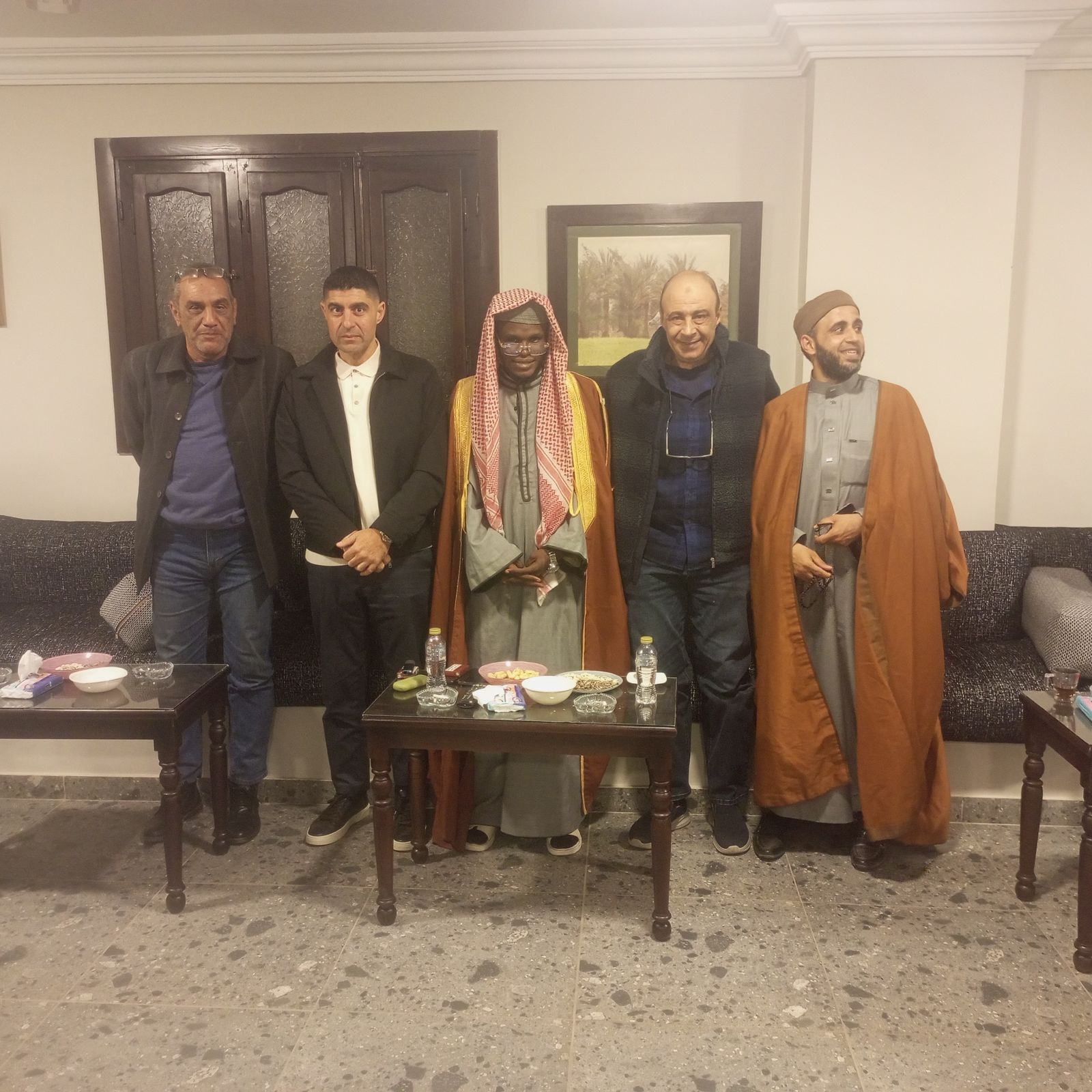
Delegations abroad, photographed on visit.
Scholarly Ties Abroad
The Institution's Islamic and Qur'anic programme is grounded in real scholarly relationships. Visits like these connect the school to the wider community of Islamic scholarship its curriculum draws on. Beyond the classroom, the school extends its reach through free community lectures, humanitarian relief, and infrastructure support such as road maintenance and community electrification.
Source: independent reporting by Punch Newspapers, August 2023.
Our Crest
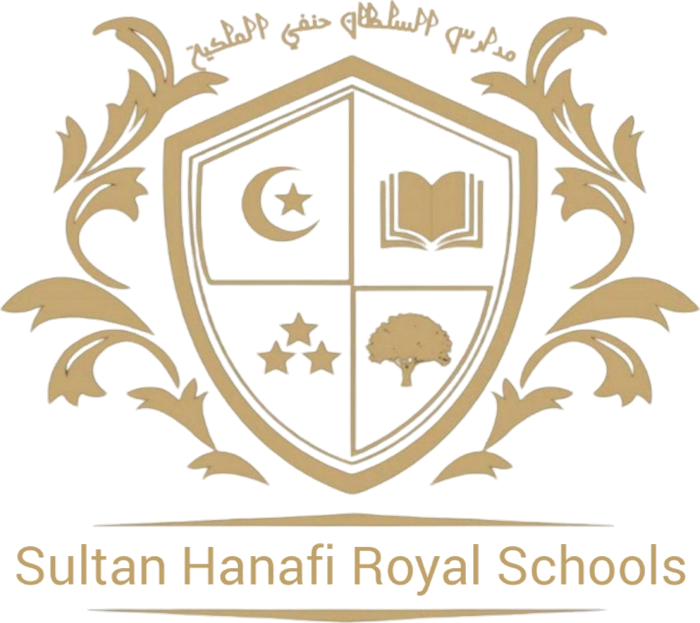
A shield is a promise made in shorthand. Ours is quartered, and each quarter names something the school has agreed to be held to.
Faith, set at the head of the shield — because everything taught beneath it answers to that first. Islam here is not a subject on the timetable; it is the ground the timetable stands on.

Knowledge, held open. A closed book guards; an open one gives. The device is a standing undertaking that what is known here is taught here — to Muslims and non-Muslims, to sons and daughters, without reservation.

Discipline, character and excellence — three, because not one of them survives alone. A disciplined child without character is merely obedient, and character without excellence asks too little of a life.

Growth measured in decades. The tree is the one device on this shield that cannot be hurried — and the school was built the same way: rooted in Imowonla, grown season by season, and intended to outlast the people who planted it.
The shield draws itself as the band is reached. Rest on a quarter — or on its card — and the other lights with it.
Our Foundation
“To provide holistic education by imparting both Islamic and secular knowledge through rigorous research and effective teaching methods — promoting ethical behaviour and instilling strong values in pursuit of a secure, informed, and progressive society.”
Adopted by the Board of Governors, and carried here in the words in which it was adopted.
What that means in practice is a single academic standard, applied without exception. Every subject this school teaches — Mathematics, the Sciences, Information and Communication Technology, the Humanities, Languages, Arabic and the Islamic sciences alike — is a department with named staff, a written scheme of work, and examinations set and marked on the same terms. Nothing is taught as a supplement to anything else, and no subject is graded more gently than another. That parity is the whole of the school’s method, and it is what makes rigorous research and effective teaching a claim the institution can be held to rather than a phrase in a paragraph.
“To be recognised as a leading institution excelling in knowledge dissemination and character building — creating a positive impact wherever our presence is felt.”
Adopted by the Board of Governors, and carried here in the words in which it was adopted.
The institution asks to be measured rather than described, and offers four measures. The first is academic: pupils sit the BECE, WAEC and NECO under the same conditions as every other candidate in Nigeria, on papers set and marked by the same national bodies. The second is what a graduate can carry away and have checked — a national qualification, and, where it is earned, an Ijāzah examined by named scholars, each entered in the register under a reference a stranger can verify twenty years later. The third is how the school teaches: a Digital Campus that puts a pupil’s whole record in their family’s hands, and a governance library published entire. The fourth is what the Imowonla community can do that it could not do before this school stood here.
Our Values
Six values, held to the same measure across every one of our institutions.
Innovative thinking. Children here are taught to build, cost and pitch something of their own.
Empowering leaders who lead early, and lead justly.
Active participation. A serious matter concerning a child reaches the guardian the day it happens.
Well-rounded growth across faith, scholarship and skill.
Moral responsibility as the ground everything is built on.
Trust & accountability — what the school says, families can check.
Who Runs This School
A Board of Governors holds the institution to account. Beneath it, each school is led by a named head who answers for it, in public, on this website.
Head Teacher, Nursery and Primary School. Accountable for the earliest years, ages two to ten: the Nigerian curriculum with Islamic formation running through it, and the years in which reading, arithmetic and self-command are either established or they are not.
Principal, Royal College. Accountable for the secondary school, JSS1 through SSS3, and for its academic departments and its biology and chemistry laboratories. His students sit the BECE, then WAEC and NECO.
Principal, School of Islamic and Arabic Studies. Accountable for the Arabic and Islamic sciences programme, taught to the Saudi Arabian curriculum on weekdays and at weekends. It is open to the wider Muslim Ummah at any age, adults included, and follows the same standard admission process as the school's other enrolled institutions.
Principal, Qur'an College. Accountable for the Hifz programme, the complete memorisation of the Qur'an, which runs 24 to 36 months and ends in Ijazah. The college takes day students, and boarders aged nine to sixteen.
The fifth institution, the Online & Distance Learning School, is newly constituted under the Head of Schools / Administrator's office. Its programme details are not yet published, and we will not publish them before they are settled. The Board of Governors, its committees and the full management structure are set out on the Governance and Leadership page.
One Board, Five Schools
Five institutions share one campus, one Board of Governors and one CLEVER standard. They do not share an age range, a curriculum or a way in. Name an age and the ones that take it will light.
All five shown.
| Institution | Ages | What is taught | Curriculum | The way in | Answered for by |
|---|---|---|---|---|---|
| Nursery and Primary SchoolThe Basic School | 2 to 10 · Day | Whole-child formation, secular and Islamic together | Nigerian National Curriculum, Islamic-infused | Standard application | Mrs. Mariam Tope Anofi-AbdulKareem |
| Royal CollegeEstablished 2021 | 10 to 18 · Day | JSS 1 through SSS 3, across its academic departments | Nigerian National Curriculum, to BECE then WAEC and NECO | Standard application | Dr. Adegoke Musa Olatunji |
| School of Islamic and Arabic StudiesThe Islamiyyah School | Any age, adults included | Arabic to genuine proficiency, Qur'ān and Ḥadīth studies | Saudi Arabian curriculum, Saudi-approved textbooks | Standard application | Shaykh Abubakr Solah |
| Qur'an CollegeDay & boarding | Boarding 9 to 16 · day students also taken | Ḥifẓ — the complete memorisation, 24 to 36 months, ending in Ijāzah | Ḥifẓ and the Qur'ānic sciences | Standard application | Imam Ahmad Sulaimiy |
| Online & Distance Learning SchoolNewly constituted | Not yet announced | To be published | To be published | Enquire | The post is constituted; the appointment is pending |
Where an age sits on the boundary between two institutions, the entrance assessment settles the placement — a child is offered the class they have qualified for rather than the class their birthday suggests. See each institution in full · Begin an application
What Is Actually in the Building
Thirteen dedicated spaces, each built for a specific purpose rather than borrowed for one — in four groups.
Dedicated laboratories and workshops that turn theory into hands-on discovery.
Three science laboratories, which is what the practical component of the WAEC and NECO papers actually requires.
Shared spaces where the school gathers, presents, and grows a love of reading.
The Studio is where the CLEVER standard is demonstrated publicly rather than described.
Care and play built into daily campus life, not an afterthought.
A currently certified First Aider is present throughout the school day.
The physical heart of a school built on faith and scholarship together.
One room, listed alone, because it is the one the timetable is built around.
Pastoral Care & Safeguarding
A school is best judged on the ordinary day something goes wrong. Here is what is in place, and where a parent can read it in full before enrolling.
A currently certified First Aider is on duty on the campus through the school day, and certification is renewed on a defined schedule — so that “certified” means certified now rather than certified once. A First Aider who recognises an incident beyond their training escalates it rather than exceeding it.
Anything beyond minor first aid is escalated at once to the school’s nurse. The campus keeps a sick bay — a room a child can be taken out of class to and watched in, rather than sent home by default — with a first-aid cabinet held to the standard set out in SW-06.
Any safety incident, any illness beyond minor first aid, and any substantive disciplinary matter is communicated to the guardian the same day. A parent does not learn about a difficult week at the end of term.
The Child Protection & Safeguarding Policy is published in full, alongside the rest of the policy library, so a family can read the standard we hold ourselves to before they trust us with a child.
Read the Child Protection & Safeguarding Policy and the full policy library.
Outside These Walls
Five Sultan Hanafi students represented the school at the SPELL Africa International Spelling Leaders Competition, and each returned with a medal — gold among them.
Recorded on the Academics page under Outcomes.
The school was independently reported by Punch Newspapers in August 2023 — the source behind the account of its community work on this page. It was not a piece we placed, and we do not reprint it here as though it were our own.
2023 · the fifth entry on the timeline above.
Royal College opened in 2021, and a pupil entering at JSS 1 spends six years reaching SSS 3. Aggregate pass rates and destination lists are published once a full cohort has passed through the school end to end — not before. Until that cohort completes, the Registrar's Office answers the question directly, in writing, for any family that asks.
A school that quotes a pass rate from a partial cohort is quoting a number it cannot yet own.
Beyond the Gates
A school is not the only thing the founding family built. The Foundation is a separate, non-profit and non-political body — Incorporated Trustees of Sultan Zakariya Hanafi Foundation — founded by Dr. Zakariya Olanrewaju Anofi and Mallam Lukman Ayinla Anofi. It has six focus areas, and those six are the whole of its present work; nothing is announced before the Trustees adopt it.
Read the Foundation's own page · Open to support from individuals, organisations, aid agencies and NGOs.
Our Undertaking
Every prospectus promises a safe and inclusive environment. Below is the same promise written as five things a family can hold us to, and check.
Attestations
Most parents have confirmed that the values and morals the school instils in our children are worth more than the money we pay. I would recommend the school to anybody.
This is the one attestation the school has published. It is set here under a name and a relationship, because an anonymous testimonial proves nothing and costs nothing to write. If your child is here and you would put your name to a sentence about it, the school will set it beside this one — write to the Registrar's Office.
Before You Ask
The seven the admissions desk answers most often — answered here in the same words the school uses everywhere else.
Yes. Our doors are open to Muslims and non-Muslims, to sons and daughters alike. The Islamic formation runs through the school day and is not optional, but it has never been a condition of admission.
The fee schedule is issued by the Bursary for each academic year and given to you in writing for the class you are applying to, together with anything available by way of scholarship or financial support. It is given in writing rather than posted here because a figure left on a website goes stale and a family plans around it.
The admission form itself carries a charge, confirmed by the admissions office. Registering for the Parent Portal is free, and tuition is paid once the offer is in your hands — not before.
The BECE at the end of junior secondary, then WAEC and NECO at the end of senior secondary. Those are the same papers, set and marked by the same national bodies, as every other candidate in Nigeria. There is no internal certificate standing in for them, and no separate, gentler track for a student carrying a heavy Arabic and Islamic Sciences load.
Three things open your child's admissions file: the birth certificate, two recent passport photographs, and a report or testimonial from any previous school. The application itself is made from a free Parent Portal account, and every stage of it is recorded there — including the decision, whether that decision is an offer, a waitlist place, or a decline.
Yes. The School of Islamic and Arabic Studies is open to the wider Muslim Ummah at any age, adults included. It runs on weekdays and at weekends, teaches to the Saudi Arabian curriculum, and follows the same seven-step digital admission process as the school's other enrolled institutions — see Admission for how it works.
Qur'an College takes day students and boarders aged 9 to 16. Full boarding runs Monday to Sunday; half boarding, Monday to Friday. At least one warden is awake and present in each boarding house overnight, with a second reachable within the site, and rooms are checked at lights-out and at least once more during the night.
On the public verification portal, with no account and no fee. Any certificate, graduation document, identity card or fee receipt is confirmed against the school's own register. An Ijāzah is signed by the examining scholars and entered permanently under a unique reference number — which is why a graduate can have it verified twenty years later.
If You Are Coming
15 Imowonla Road, AP Bus Stop,
Off Gberigbe–Agura Road,
Ikorodu, Lagos State, Nigeria
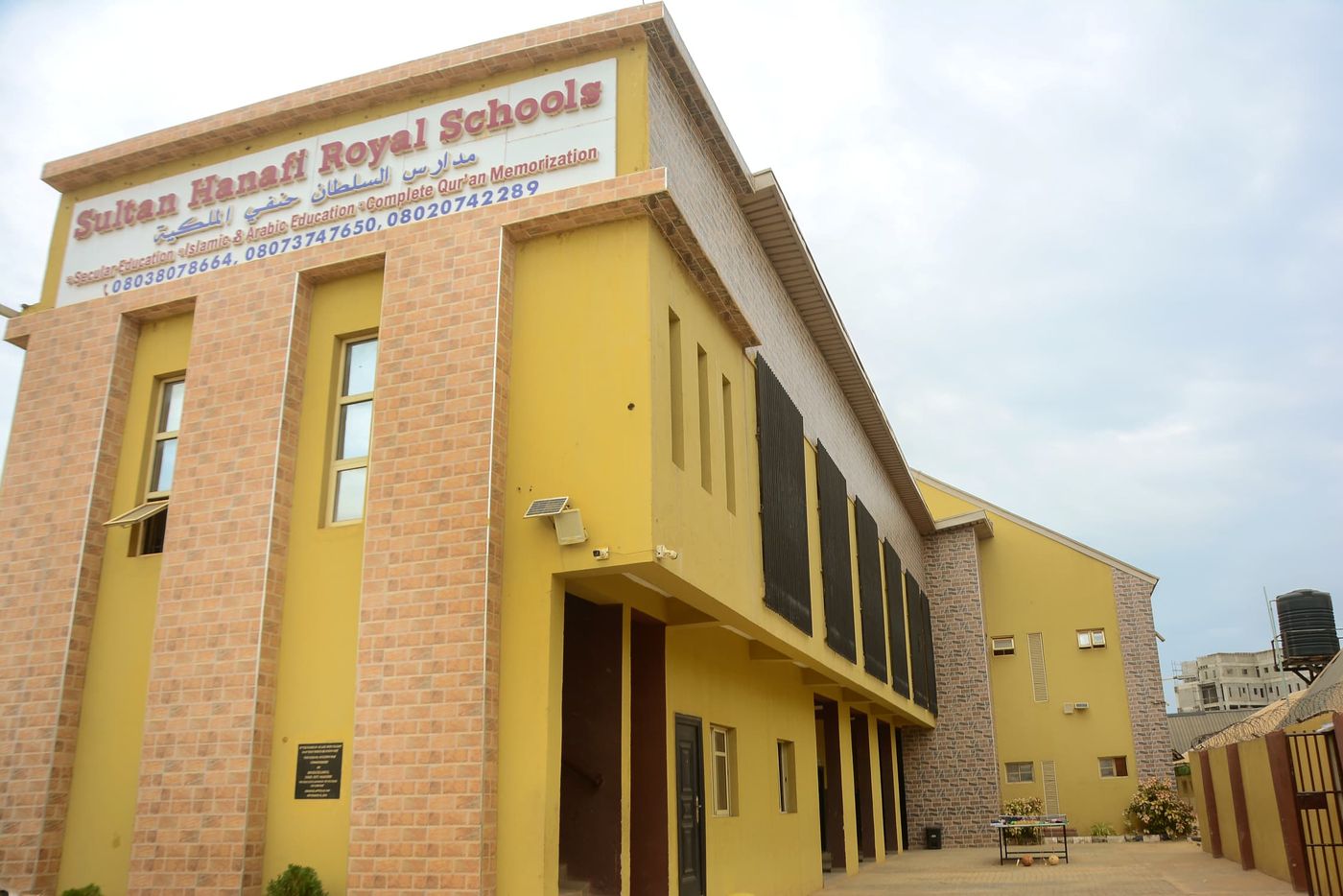
Take the Gberigbe–Agura Road and turn at the AP Bus Stop into Imowonla Road. The campus is at number 15, on the left, behind the green gate carrying the school's name.
Thursday and Friday close earlier for the Jumu'ah observance and the week's close. The institution is open seven days a week.
+234 807 374 7650
+234 807 058 6860
Send a WhatsApp message or telephone ahead before you set out. Every enquiry received is entered on the register and answered by a named officer.
Sultan Hanafi Royal Schools
The best way to understand a school is to stand inside it. Begin an application, arrange a visit, or explore the five institutions that make up Sultan Hanafi Royal Schools.
I'm an AI assistant, not a staff member — I can answer questions about the school and help with schoolwork, but for anything official please use the contact details below.
Before you begin
This site is published in seven liveries. Every one of them carries the same words, the same photographs and the same standard of legibility — only the colour changes. Move across them to see the page change beneath, and choose the one you would rather read in. You can change it again at any time in the Personalisation Centre.
More settings — type size, reading mode, motion, prayer times and the rest — are in the Personalisation Centre.